How to Get Rid of Fungus Gnats for Good (Even in Winter)
You notice them first as tiny black specks flying up when you water your peace lily. They hover around the soil, land on leaves, and reappear no matter how often you wipe them away.
They’re fungus gnats — small, fragile flies that thrive in moist potting mix — and while they look harmless, their presence can signal deeper problems: overwatering, poor drainage, or decaying organic matter in the soil.
The good news? You don’t need harsh chemicals. With a few consistent steps, you can eliminate fungus gnats — even in winter, when windows stay closed and humidity runs high.
In this guide, you’ll discover:
- What attracts fungus gnats and why they appear
- How to break their life cycle at every stage
- Natural, non-toxic methods that actually work
- How to prevent them from coming back
Because peace of mind shouldn’t come with wings.
🐛 Why Fungus Gnats Love Your Indoor Garden
Fungus gnats (Bradysia spp.) are not attracted to plants themselves — they’re drawn to damp soil rich in decaying organic material. Their larvae feed on fungi and root hairs in wet potting mix, which can weaken young or stressed plants over time.
Adults live only about a week but lay hundreds of eggs in moist soil. This means an infestation can grow fast — especially in winter, when indoor air is dry, prompting us to water more, while light levels remain low, slowing evaporation.
According to the University of California Statewide IPM Program, fungus gnats are most active in temperatures between 70–80°F — common in heated homes — and complete their life cycle in just 17–28 days under ideal conditions.
So yes — that tiny fly buzzing near your monstera could already have dozens of offspring living beneath the surface.
🔗 Source: UC IPM – Managing Fungus Gnats Indoors
But here’s the silver lining: fungus gnats are weak flyers, easy to trap, and highly sensitive to changes in moisture.
That means you can stop them before they take over.
🧼 Step-by-Step: Break the Life Cycle
To get rid of fungus gnats for good, you must target both adults and larvae. One treatment isn’t enough — consistency is key.
1. Let the Soil Dry Completely
This is the most effective step.
Larvae cannot survive in dry conditions. Let the top 2–3 inches of soil dry out completely between waterings.
For most houseplants, this means waiting until the soil feels dry deep down — use your finger or a wooden chopstick to check.
Avoid watering on a schedule. Instead, follow the plant’s needs.
📌 Note: Some tropicals like calathea may wilt slightly during drying — mist lightly if needed, but avoid soaking the soil again too soon.
🌿 Internal Link: Perfect Watering Indoor Plants: Avoid Root Rot
2. Replace the Top Layer of Soil
Since eggs and larvae live in the upper inch of soil, remove it.
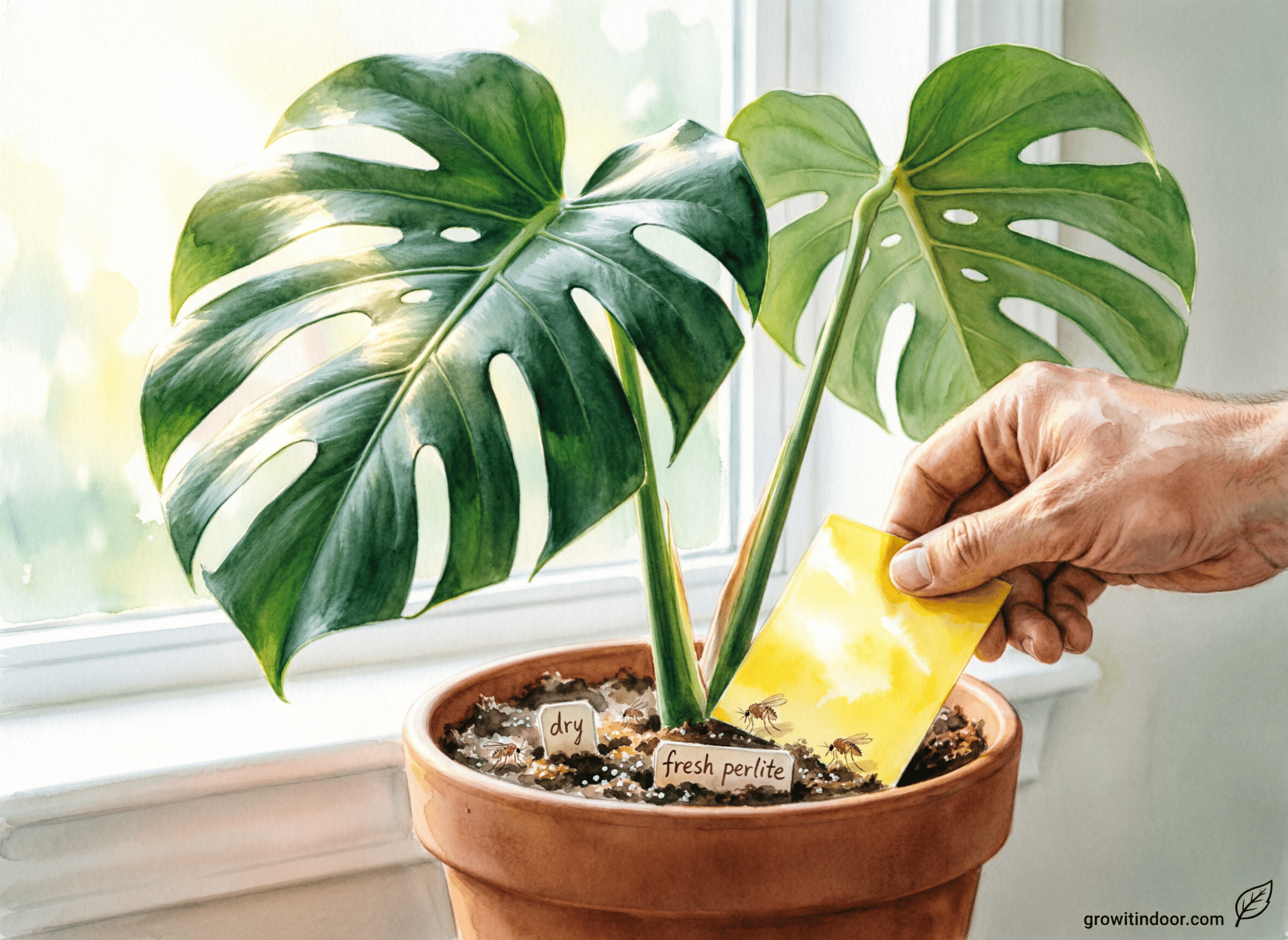
Carefully scrape off the top 1–2 cm of potting mix and replace it with fresh, dry perlite or vermiculite. This creates a dry barrier that deters egg-laying adults.
Do this carefully — avoid damaging roots — and do it for all affected plants.
3. Use Yellow Sticky Traps
These bright yellow cards attract adult gnats with UV reflection.
Place one or two near each infected plant, just above the soil line.
Check weekly. When covered, replace them.
This won’t kill larvae — but it stops adults from laying more eggs.
✅ Bonus: It helps you monitor progress. Fewer bugs caught = success.
4. Apply Hydrogen Peroxide Drench
A safe, natural way to kill larvae without harming roots.
Mix 1 part 3% hydrogen peroxide with 4 parts water.
Pour slowly into the soil until fully saturated.
It will foam slightly — this is normal. The reaction releases oxygen, killing larvae and aerating compacted soil.
Repeat once after seven days to catch newly hatched ones.
⚠️ Never use full-strength — always dilute.
🔗 Source: University of Florida IFAS – Fungus Gnat Control in Houseplants
5. Try Beneficial Nematodes (For Severe Cases)
Microscopic worms called Steinernema feltiae naturally hunt fungus gnat larvae in moist soil.
Available online or at garden centers, they’re mixed with water and applied to pots.
Safe for pets, humans, and plants — but require consistent moisture and cooler temps (below 85°F).
Best used in spring or early fall — less effective in very dry winter air.
❌ What NOT to Do
- Don’t spray vinegar or essential oils → harms leaves and doesn’t reach larvae
- Don’t keep spraying water daily → keeps soil damp and invites more gnats
- Don’t ignore signs of overwatering → drooping leaves aren’t always “thirsty”
- Don’t reuse old potting mix → may contain dormant eggs
🌱 Prevent Future Infestations
Once they’re gone, keep them away:
Use Well-Draining Potting Mix
Add extra perlite or orchid bark to standard soil — improves airflow and reduces compaction.
Avoid Organic Crusts
Don’t leave coffee grounds, tea leaves, or compost on top of pots — they attract pests.
Water Mindfully
Only when the soil is dry. Bottom watering helps control moisture better than top-down.
Quarantine New Plants
Keep new arrivals isolated for 1–2 weeks and inspect soil before placing near others.
🌿 Internal Link: Common Houseplant Pests: Identify & Eliminate
✅ Final Thought: Stillness Over Panic
Getting rid of fungus gnats isn’t about speed — it’s about rhythm.
No single spray will fix everything overnight. But gentle, consistent care? That works.
Each dry day.
Each clean saucer.
Each moment you choose patience over panic.
You’re not just saving your plants.
You’re reclaiming calm.
Because sometimes, the smallest invaders remind us of the deepest truth:
True strength grows quietly — in dry soil, steady hands, and breath after breath.