
How to Grow Peppers Indoors Year-Round: Jalapeño, Bell & More
You crave the bright pop of a fresh jalapeño on your tacos. The sweet crunch of a homegrown bell pepper in your salad. The slow, smoky warmth of a roasted poblano. But you live in an apartment. Your balcony faces north. Winter lasts six months.
What if you could grow all of them—right on your kitchen counter?
The truth? You can grow peppers indoors year-round—not just survive, but thrive and harvest fresh, flavorful fruit even in January. You don’t need a greenhouse. You don’t need a backyard. You just need the right variety, the right light, and a little patience.
As an urban horticulturist who’s harvested peppers from a 4th-floor studio in Paris for over a decade, I’ve learned that the secret isn’t magic—it’s science. And I’ll show you exactly how to do it.
- Why Peppers Are Perfect for Indoor Gardens
- Best Compact Pepper Varieties for Indoors
- Light: The Non-Negotiable Factor
- Step-by-Step: How to Grow Peppers Indoors
- How to Pollinate Pepper Flowers Indoors
- Care Tips for Healthy Plants & Fruit
- FAQ: Your Questions Answered
Why Peppers Are Perfect for Indoor Gardens
Peppers aren’t just vegetables—they’re miniature sun-catchers. They thrive on warmth, light, and consistency. And indoors, you control all three.
Benefits of growing peppers indoors:
- Year-round harvest: No more waiting for summer. Pick peppers in December.
- Superior flavor: Homegrown peppers are sweeter, crisper, and far more aromatic than store-bought.
- No pesticides: Grow organically, without chemical sprays.
- Space-efficient: Compact varieties fit in a 5-gallon pot.
- Therapeutic joy: Watching a tiny flower turn into a vibrant fruit is deeply satisfying.
According to the Royal Horticultural Society, peppers are among the most rewarding crops for container gardening—with the right conditions, they can produce for over a year.
Best Compact Pepper Varieties for Indoors
Forget giant bell peppers. Choose dwarf, fast-maturing, and high-yielding types bred for small spaces.
1. ‘Lunchbox’ (Bell Pepper)
Heat level: 0 SHU (sweet)
Maturity: 55–60 days
Plant size: 12–18 inches tall
Fruit: Mini bell peppers in red, orange, yellow—perfect for snacking
2. ‘Jalapeño M’
Heat level: 2,500–8,000 SHU (medium)
Maturity: 70–75 days
Plant size: 18–24 inches
Fruit: Classic green-to-red jalapeños, very productive
3. ‘Thai Hot’
Heat level: 50,000–100,000 SHU (very hot)
Maturity: 80 days
Plant size: Compact, bushy, 12–18 inches
Fruit: Tiny red peppers, perfect for stir-fries and sauces
4. ‘Patio Snacker’ (Bell)
Heat level: 0 SHU
Maturity: 60 days
Plant size: 14 inches tall
Fruit: Crisp, snack-sized bells—ideal for windowsills
5. ‘Cayenne’ (Compact)
Heat level: 30,000–50,000 SHU
Maturity: 70 days
Plant size: 18–20 inches
Fruit: Long, slender red peppers—perfect for drying
Avoid: Large bell varieties like ‘Big Bell’ or ‘California Wonder’—they need too much space and heat.
Light: The Non-Negotiable Factor
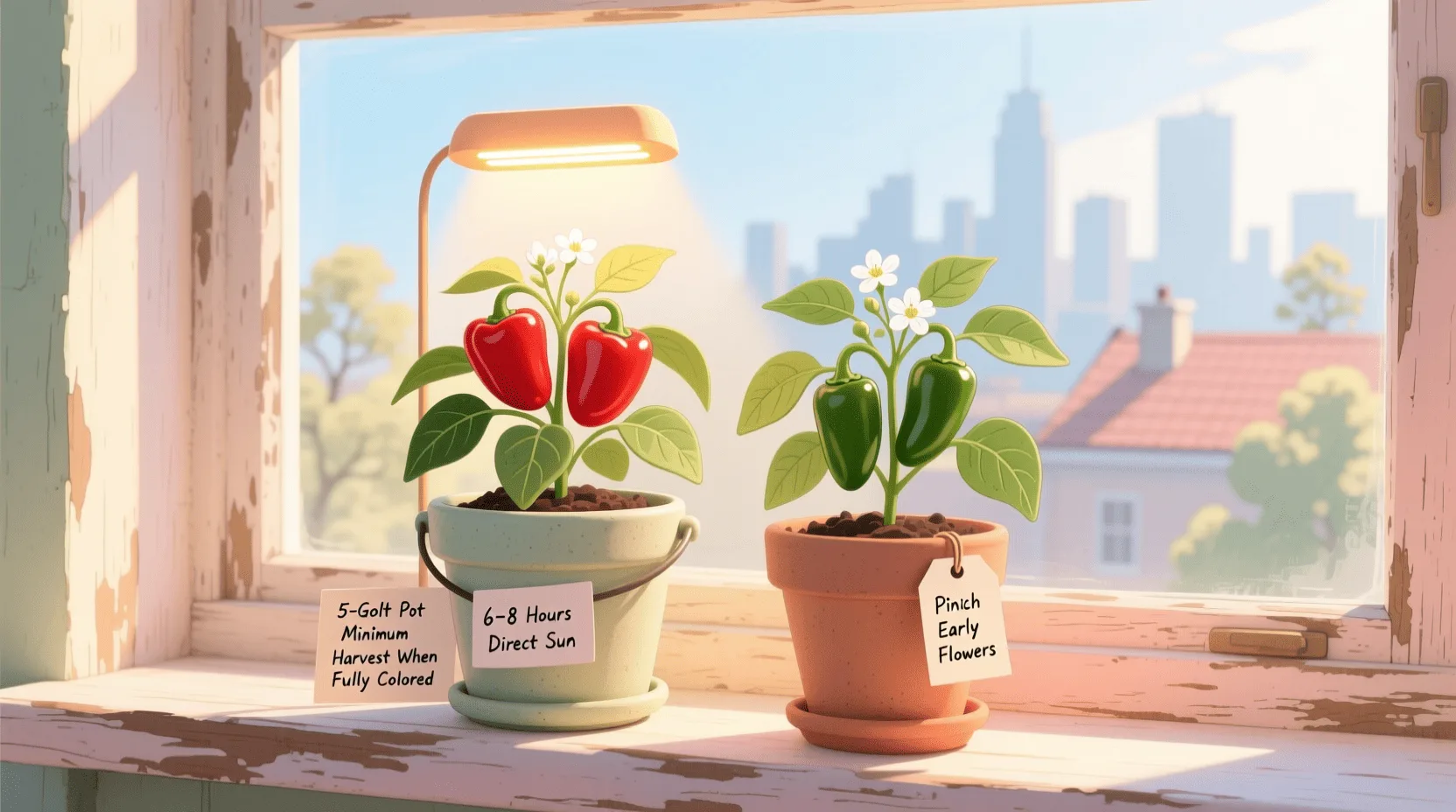
Peppers are sun worshipers. They need 6–8 hours of direct sunlight daily to flower and fruit.
But if you don’t have a south-facing window—or if you’re growing in winter—you need supplemental light.
How to Provide the Right Light
- Use a full-spectrum LED grow light (6500K)—this mimics natural daylight.
- Position it 6–12 inches above the plant—too far = leggy growth. Too close = leaf burn.
- Run it for 12–16 hours per day—use a timer for consistency.
- Keep the room warm: Peppers stop growing below 60°F (15°C). Ideal range: 70–85°F.
Without enough light, your plant will grow tall and spindly, drop flowers, and never produce fruit. This is the #1 reason indoor pepper growers fail.
See our guide to choosing the right LED grow light for small spaces.
Step-by-Step: How to Grow Peppers Indoors
What You Need
- 5-gallon container with drainage holes (minimum)
- Quality potting mix + compost (2:1 ratio)
- Compact pepper seedlings or seeds
- Full-spectrum LED grow light (if no south window)
- Small stake or trellis (optional, for support)
Step-by-Step
- Start seeds indoors 8–10 weeks before your last frost (or anytime if using grow lights). Use a seed tray with a heat mat (75–80°F).
- Transplant to a 5-gallon pot when seedlings are 6 inches tall and have 4–6 true leaves. Gently loosen the root ball.
- Place in full sun or under LED light immediately. Don’t wait.
- Pinch off the first flowers (when they appear). This forces the plant to focus energy on root and stem growth.
- Water deeply when the top inch of soil is dry. Peppers hate soggy roots but hate drought too.
- Feed every 2–3 weeks with a balanced organic fertilizer (e.g., 5-5-5) once flowering begins.
- Harvest when fruits are fully colored—green peppers are unripe. Red, yellow, or orange means peak flavor.
See our tomato guide for companion growing tips—peppers love similar conditions.
How to Pollinate Pepper Flowers Indoors
Peppers are self-pollinating—but indoors, there are no bees or wind. You must help.
- Gently shake the plant daily—this releases pollen.
- Use a small paintbrush or cotton swab: Gently swirl it inside each open flower to transfer pollen.
- Do this in the morning when flowers are most receptive.
Look for tiny yellow pollen dust on the brush—that’s success. If flowers drop without fruiting, it’s usually a sign of poor pollination or low light.
Care Tips for Healthy Plants & Fruit
- Use a 5-gallon pot minimum—peppers have deep roots. Smaller pots = stunted growth.
- Keep humidity between 50–70%—peppers like it moist. Use a humidifier or pebble tray if your air is dry.
- Rotate the pot weekly for even growth and maximum light exposure.
- Prune lightly: Remove yellow leaves and suckers (small shoots between branches) to improve airflow.
- Harvest regularly: Picking fruit encourages the plant to produce more.
Remember: healthy roots = healthy fruit. Never let the soil dry out completely, and never let it sit in water.
FAQ: Your Questions Answered
Q: Can I grow peppers in a north-facing window?
A: Not without supplemental light. They need 6–8 hours of direct sun daily.
Q: How long do pepper plants live indoors?
A: With proper care, they can live 2–3 years as perennials. Many growers keep them going through winter and harvest again the next season.
Q: Why are my flowers falling off?
A: Usually due to low light, cold temperatures, or lack of pollination. Check your light and humidity.
Q: Do I need two plants to get fruit?
A: No. Peppers are self-fertile. One plant can produce a full harvest.
Q: Can I grow hot and sweet peppers in the same pot?
A: Technically yes—but cross-pollination may make sweet peppers slightly spicy. Best to grow them separately.
Q: How many peppers will one plant produce?
A: 15–30+ per season, depending on variety and care. ‘Jalapeño M’ can produce over 50 peppers!
Q: Can I grow peppers without a grow light?
A: Only if you have a south-facing window with at least 6 hours of direct sun daily. Otherwise, use a grow light.
Growing peppers indoors isn’t just about food. It’s about reclaiming flavor, connection, and joy in a world of bland, shipped produce. When you bite into a pepper you grew on your windowsill, you’re not just tasting spice—you’re tasting resilience, patience, and the quiet power of growing your own.
If this guide helped you grow your first indoor pepper, share it with a fellow urban gardener. And tell us: what pepper will you grow first?
Can you be more specific about the content of your article? After reading it, I still have some doubts. Hope you can help me.
Your article helped me a lot, is there any more related content? Thanks! https://www.binance.info/register?ref=IHJUI7TF
I don’t think the title of your article matches the content lol. Just kidding, mainly because I had some doubts after reading the article.
Can you be more specific about the content of your article? After reading it, I still have some doubts. Hope you can help me. https://accounts.binance.info/register-person?ref=IXBIAFVY
Your point of view caught my eye and was very interesting. Thanks. I have a question for you. https://accounts.binance.com/uk-UA/register?ref=XZNNWTW7
Can you be more specific about the content of your article? After reading it, I still have some doubts. Hope you can help me. https://accounts.binance.com/register-person?ref=QCGZMHR6
Thank you for your sharing. I am worried that I lack creative ideas. It is your article that makes me full of hope. Thank you. But, I have a question, can you help me? https://www.binance.info/register?ref=IHJUI7TF
Thanks for sharing. I read many of your blog posts, cool, your blog is very good.
Thanks for sharing. I read many of your blog posts, cool, your blog is very good.
Thanks for sharing. I read many of your blog posts, cool, your blog is very good.
Can you be more specific about the content of your article? After reading it, I still have some doubts. Hope you can help me.